Service Design · UX Design · Product Design
Vital Guards
Establishing a field-based triage ecosystem linking patients, responders, and data at the scene of a mass-casualty accident

Type
Student project
My role
UX Designer
Period
6 weeks
Year
2025
Team
Caroline Krasnosselski — Brand identity
Trisha Wettstein & Abirshana Thayalakuru — Product design
Anna Senko — UX Design
·
small, wireless sensors that pair with a smartphone to turn it into a diagnostic and decision-support hub
·
for a medical team to quickly assess, monitor, and treat up to 20 injured people after an accident in a remote area

Research
LEARNING HOW REAL TRIAGE DECISIONS GET MADE
·
Researched existing triage systems: how they’re set up, the staffing and equipment they require, and how patient assessment and treatment are sequenced
·
Interviewed emergency medicine practitioners to understand how triage really unfolds in the field
·
Synthesised findings with the design team to identify where a wearable and shared dashboard could remove the biggest bottlenecks
Dr. med. Vanessa Moll
Intensivist and Anesthesiologist, Consultant at the Institute for Anesthesiology, USZ
Dr. med. Adrian Marty
Senior Attending Physician at the Institute for Anesthesiology, USZ, and Director of Medical Education at the Simulation Center, USZ
Dr. Thomas Lumpe
Postdoctoral Researcher at the Engineering Design and Computing Laboratory (EDAC), ETH Zurich, Ph.D. in Computational Design and 3D Printing
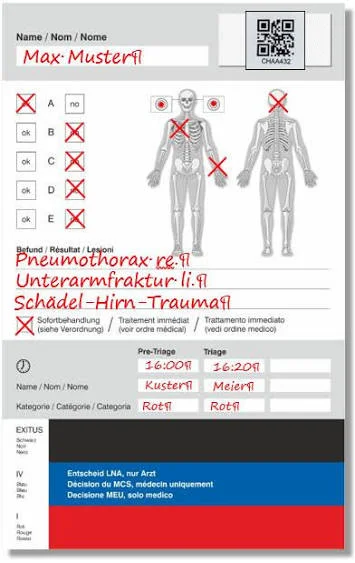
Patient Card (Current)

Sensor’s Placement

Staff Shortage
Too few medical responders are ever available to match the number of injured at a mass-casualty scene

Assessment Delay
Patient priorities shift by the minute, so a single initial triage assessment goes stale almost immediately
Analog Overload
Paper-based documentation forces doctors to lose precious time

Handover Gaps
Without a shared, real-time overview, incoming teams lose track of how each patient’s condition has evolved
Research Question
Project Development
User Journey
The first step of the process was mapping a complete patient journey, from the initial emergency call through field treatment to hospital arrival and handover

AI as Support, Not Judge
The AI algorithm can replace a coordinator by queuing patients for treatment, but only doctors can evaluate a patient’s actual condition
Universal Wearable
Every patient receives a quick-attach wristband that continuously measures heart rate, oxygen saturation, blood pressure, temperature, and respiratory rate
Local Setup
The entire system is pre-connected and ready to operate instantly, without any dependence on internet access in the field
Design Process
Interface Interactions
The core design principle was maximizing productivity through minimal interaction, creating an interface that stays minimalistic yet information-rich, surfacing only what’s critical in the moment

Patient’s Overview

Patient’s Card
Patient Identification
Find a clear way to identify each patient and instantly see their current stage of treatment
Deeper Patient Card
Include detailed view of treatment history, vitals graphs, and detailed injury
Project’s Evolution
To address the patient identification challenge, the next phase focused on designing a clear visual ID system that lets responders instantly recognize each patient and track their treatment stage at a glance
Data Input (New)
Patients Overview (New)

Quick Input
Data entry relies on taps and voice input instead of typing, letting medics log patient information in seconds
Alert Section
A dedicated alert section flags changes in a patient’s vitals, signaling when a case needs immediate attention

Unique Patient ID
Every wearable carries a unique ID linked to the app, storing and syncing patient’s vital signs automatically
To address the deeper patient card challenge, the next phase expanded each patient’s profile into dedicated views for injuries, live vitals graphs, and a full treatment history
Patient Card (New)

Layers of Information
The interface surfaces a full overview at a glance, while letting responders drill into deeper details when needed

Seamless Handover
Once the event ends, all patient data is pushed to the server, so hospitals have full access the moment the patient arrives
Outcome
By transforming triage from a static assessment into real-time, data-driven prioritisation, VitalGuard helps emergency teams detect changing conditions faster and intervene before it’s too late


AI-Powered Queue
An algorithm continuously reprioritizes the treatment queue as patient conditions change
Quick Input
Fast, tap-based and voice input save time on data entry
Patient Card
A single card holds each patient’s vitals, injuries, and treatment history in one view
·
This project could only succeed through an interdisciplinary team: no single app can solve a problem this large; it requires an entire service ecosystem
·
Designing for the medical field demands deep research and continuous feedback from field experts throughout the process to deliver a solution people actually need